
Which AI audit should you choose?
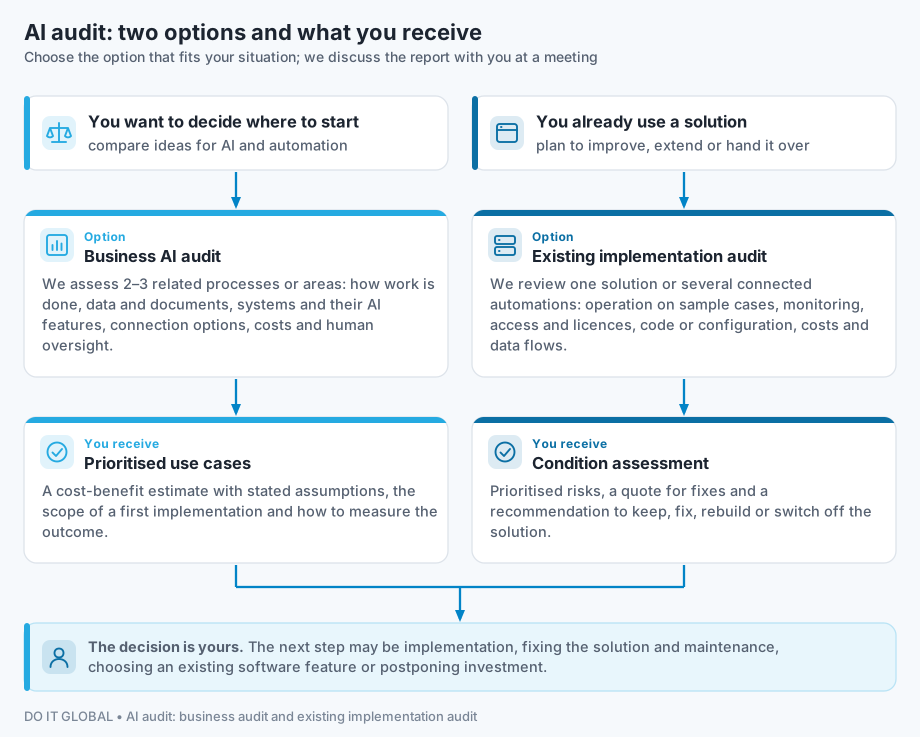
The choice depends on whether you are looking for a first use of AI or want to assess a solution your business already uses.
| Your situation | Audit and deliverables |
|---|---|
| You want to compare ideas and decide where to start | Business AI audit. We assess 2–3 related processes or areas. You receive prioritised use cases, a cost-benefit estimate and the scope of a first implementation. |
| You use automation, an integration or an AI solution and want to improve, extend or hand it over for maintenance | Existing implementation audit. We review one solution or several connected automations. You receive a condition assessment, a quote for fixes and maintenance requirements. |
We work primarily with B2B companies employing 10–250 people in trade and distribution, manufacturing including made-to-order production, and technical services. If you already know which process needs improvement and want to examine it in depth, see process analysis. The area review described there has the same scope as the business AI audit.
Business AI audit: what do we assess?
An audit helps you choose a first step, compare ideas or proposals and check what your current software can do. It is also useful when your team already uses ChatGPT or similar tools and you want to agree consistent working practices.
Within the agreed scope, we assess:
- How work is done. Case volumes, handling time, corrections and exceptions. We work through examples with the people doing the work each day.
- Data and documents. Where they come from, their format and whether they contain the information needed for automation.
- Current systems and their AI features. We examine ERP, or enterprise resource planning software, email, spreadsheets and applications. We first assess features available in your current version and licence, including AI features, then consider whether additional tools are needed.
- Options for connecting systems. Available APIs, or interfaces for exchanging data, databases, existing modules and licence terms.
- Data processing. Requirements for cloud services, a server in the EU or a server at your premises. Where local processing is needed, we also compare a private AI option.
- Costs and human oversight. Implementation, licences, AI models and maintenance, together with exception handling and points where a person approves the result.
- Team readiness. Who will use the solution and what they need for daily work. A short training session and agreed AI usage guidelines may complement the work.
Starting points include orders, quotations, purchase invoice checks or an AI assistant using company data. We tailor the audit scope to your business goal.
What do you receive after a business AI audit?
You receive a report, which we discuss with you at a meeting. A business AI audit gives you:
- Prioritised use cases. For each, we describe the potential benefit, cost, implementation requirements and risks.
- A cost-benefit assessment. A return estimate with explicit assumptions, including setup and running costs. We distinguish measured data, estimates and points requiring verification.
- The scope of a first implementation. What the solution should do, which data and systems it will use and what still needs human approval.
- A way to check the outcome. For example, total handling time including checks and corrections, or the proportion of cases requiring manual intervention.
- Reasons to defer particular changes. We also identify where an existing software feature, an integration or a change to working practices is sufficient.
We show time recovered separately from financial savings, such as reduced overtime or avoiding additional recruitment. We count each benefit once. If there is insufficient evidence to estimate a financial return, we state this in the report; the estimate supports your decision and does not guarantee an outcome.
Example report extract — fictional data
Illustrative audit at a trading company — not a client project
Suppose a company wants to handle orders and quotation requests more smoothly. The entries below illustrate how we compare options. The figures illustrate the cost of a defined implementation; priorities depend on the data and circumstances of this fictional company.
| Use case | Potential benefit | Cost and requirements | Priority |
|---|---|---|---|
| Order data transferred to a draft in the ERP | Less time entering data, with the team checking a prepared draft | Illustrative price: £4,360–£7,260 excluding VAT for a limited implementation with integration. Requires an available ERP connection, matching product references and draft checks. | First candidate. Test accuracy on samples and assess value against the company’s order volume. |
| A draft quotation using information from messages and documents | Sales staff gather the information for a quotation more quickly | Illustrative price: £2,900–£4,360 excluding VAT without ERP integration. Requires a current price list, one quotation type and approval by a salesperson. | Next step. First organise price list versions. |
| Sharing order status through the current ERP | The team can see which stage a case has reached | No AI. First check the existing module, licence and settings; quote for any configuration after that review. | Start with the existing feature. Do not implement a new AI solution at this stage. |
In a full report, the estimate uses case volumes and handling times from your business. The time needed after the change includes output checks and exceptions; we calculate licence, AI model and maintenance costs separately. This table illustrates our approach to recommendations, rather than promising a result or quoting for any implementation.
Audit of an existing AI or automation implementation
This option helps you plan how to improve, extend or hand over a solution for maintenance. You can also commission it when automation runs inconsistently, some cases need manual corrections, costs are rising or you want to establish where data goes and who has access. A review is also useful when the original developer is no longer available and documentation is incomplete.
We assess n8n and Make automations, ERP integrations, .NET applications with MSSQL databases and solutions using AI models such as OpenAI or Claude. An automation audit covers:
- Operation on sample cases. Typical cases, errors, missed or duplicated cases, exception handling and human oversight.
- Monitoring and alerts. Whether a process interruption can be detected, its cause identified and interrupted work resumed.
- Access, accounts and licences. Ownership, permissions, access token expiry and use of company or personal accounts.
- Code or configuration and documentation. Whether available materials support maintenance and changes.
- Costs and data flows. AI model and service fees, processing locations and safeguards within the agreed scope.
You receive a condition assessment, prioritised risks, a quote for fixes and a recommendation to keep, fix, rebuild or switch off the solution. We also identify the requirements for taking it into maintenance and development. An AI implementation review does not automatically commit us to maintenance; we agree its scope and price after the review.
We need agreed read-only access, documentation where available, sample cases and a discussion with someone who knows the process. Repairs and changes to a live solution form a separately agreed stage.
How much does an AI audit cost?
The price of a business AI audit depends mainly on company size and the number of processes. For both options, connections between systems and the availability of materials also matter. Prices are indicative; we agree the exact price and timescale before work starts.
| Option | Price excluding VAT and timescale |
|---|---|
| Business AI audit: 2–3 related processes or areas | £1,740–£3,480 Usually 3–5 weeks |
| Existing implementation audit: one solution or several connected automations | £1,740–£3,480 Usually 2–4 weeks |
We deduct the audit fee from further work. We deduct up to half of the price of work ordered within 30 days, and the remainder from the next work ordered within 6 months. After a business AI audit, this means implementation; after an existing implementation audit, fixes, rebuilding or extension.
An audit is optional. If the task, data and system capabilities are clear, we prepare an AI implementation proposal directly after the free consultation. The initial call lasts 30–45 minutes online; get in touch and we’ll arrange a time.
How does an AI audit work?
- We agree the goal, scope and confidentiality arrangements. We choose the audit option and agree the price, timescale and materials needed. We sign a confidentiality agreement before data is shared; examples can be anonymised.
- We examine work, systems and data. We talk to the people doing the work and go through sample cases. For an existing implementation review, we also examine code or configuration, documentation and agreed read-only access.
- We compare options. In a business audit, we assess the benefits, costs and requirements of potential use cases. In a solution review, we assess its condition, prioritise fixes and quote for them. We record assumptions and points requiring confirmation.
- We discuss the report and next step. We explain the recommendations, the scope of any further work and how to assess its outcome. You decide what happens next.
We work mainly online; we can also meet on site in Szczecin and the surrounding area. Timing also depends on access to people who know the process and materials needed for the assessment.
What does the audit fee cover?
An assessment based on your company’s work and data, with a plan you can use for implementation. We measure or estimate case volumes and handling time, check the capabilities of your ERP, email and documents, and relate recommendations to your existing systems, licences and working practices. Calculation assumptions are explicit, so you can assess what makes the change worthwhile.
For an automation review, the fee covers understanding how the solution works, a quote for fixes and requirements for ongoing maintenance. We agree the assessment scope in advance so the report addresses the decision you need to make.
Our analysis draws on over 20 years of IT experience in requirements analysis, system design, programming and implementation. Learn more about DO IT GLOBAL’s experience.
What happens after the audit?
The decision is yours. You can use the report yourself or commission us to carry out an agreed scope of work. The next step may be AI or automation implementation, integration with your business systems, or fixing a solution and handing it over for maintenance. The outcome may also be choosing an existing software feature or postponing investment.
For a recommended implementation, we agree the scope, price and acceptance criteria, then compare the outcome with the assumptions after launch. See how we work.
Content updated: